

It’s just after 11 p.m. in a cow field outside of Beaver Stadium.
Penn State just lost to USC. The mood is already low among most of the 114,419 who just left the most-attended college football game in 2026 to date.
Most of them, dressed in white, climb into their cars and the problem with attending a football game in a rural town with almost exclusively two-lane roads only makes the mood worse.
For what feels like miles in every direction, red lights, no longer white shirts, cover the scenery.
A Beaver Stadium traffic jam – almost as oppressive as the crowd noise heard a few hours early – bears down on every fan like they are the opposing quarterback. It is the byproduct of attending a football game at least two hours away from a major city at a university that was built with agriculture, not infrastructure, in mind.
Two miles north of the stadium, though, those with enough money can escape the chaos a bit more quickly.
On any given football weekend, private jets from around the country will use the 6,701-foot-long runway at State College Regional Airport as a method of transportation in and out of that traffic. It’s a runway plenty long enough for any private jet or plane to avoid maybe the most maddening part of attending a Penn State football game – even when the team’s play was maddening, like it was in the 31-23 loss to the Trojans.
On this night, a company named FanHaus claims it will offer three of flights out of the regional airport, all headed back to the New York area.
Presented as a way for those who are willing to spend a little extra, FanHaus says it helped get Penn State fans back to Manhattan before many of those still left in the snarling postgame traffic ever escaped. After the game, fans would head to State College’s airport where they would take a private plane back to Teterboro outside of New York City. There, a helicopter would be waiting to take those living in Manhattan back to the other side of the Hudson. Total time in the air: 63 minutes.
But whether or not those flights ever happened remains a question.
In oil-rich Texas, where the oil makes the rich, private charter flights are common, especially when it comes to seeing the landman’s alma mater play.
After all, the last time a team from the Lone Star State played in State College, the number of PJs overwhelmed the airport so much that golfer Bryson DeChambeau and his wealthy friends had to take a shuttle from Williamsport because their flight was diverted there. By the time they arrived at Beaver Stadium, Kevin Jennings had already thrown his second pick-six.
And while trips up north don’t happen a ton, one company saw an opportunity to tap into the want to fly private and the need to cheer on that passenger’s favorite team.
Game Day Private Jets is a Department of Transportation Part 380 certified company that offers private charter flights with FAA-certified Part 135 direct air carriers to college football games around the country.
In other words, they are a legitimate company that uses private flights to also help athletic departments and NIL collectives make money.
“Game Day Private Jets was really purpose-built for the modern era of college athletics, where there’s a constant pressure to generate external revenue for athletics as well as create new experiences for fans, donors and season ticket holders,” Game Day Private Jets’ Dylan Orenstein said in an interview. “What we’ve seen in the market is there’s a lot of donor fatigue. So how do we offer a really exciting, affordable solution for what many college towns and games is a logistical nightmare of getting onto these small towns”
“Affordable” is relative, but starting at $2,000 per person round trip, the company will help fans of schools like Texas, Texas Tech and Tennessee get to around – all while supporting all three of those schools’ NIL collectives with the revenue generated.
That $2,000 price tag however, is far cheaper than owning a jet outright. So what Game Day Private Jets will do is essentially connect people in a given area looking to head to that Saturday’s game and split the cost.
“When you’re buying an individual seat on a private jet, you may have one or two seats for you and your spouse,” Orenstein said. “ And you’re flying with six, eight, 10 other guys and gals who love the university, who are in a similar situation. There’s an opportunity to potentially do business together, but you really just meet new people and engage with your alumni in a unique way.”
Game Day Private Jets offers paid membership that gives the member access to priority access on flights. Membership costs around $949 a year on top of the round-trip flight cost(s) – which can vary between fully private experiences or a shuttle-type flight.
According to paperwork filed under Part 380, which is required to operate this type of business, Game Day offers flights on planes as small as Pilatus PC-12s (eight people) to a Bombardier CL850, up to 18 seats. Game Day then works with FAA Part 135-certified carriers like Tradewind Aviation and Contour Airlines. That license is required of those companies to operate and execute flights on smaller planes compared to commercial jets.
Additionally, Orenstein says the company offers additional services that members can use with revenue generated from flights outside of games – like vacation or work – still going back to the passenger’s team’s NIL fund.
“We’ve had members say, ‘Wait, if I fly for business or if I fly on a family vacation, money will go back to Texas Tech?’ We’re like, ‘absolutely.’ And they’re like ‘Well, I’m doing all my business travel with you guys then’ because they want to support athletics in a way that they never thought they could before.”
Of the 2026 charters listed, Game Day is authorized as the charter operator to airports close to many schools throughout the country, including Penn State, Michigan, Ole Miss and Florida. Game Day Private Jets also offers to take alumni and fans to March Madness games and the College World Series.
While Orenstein is a Penn State alum himself, Game Day Private Jets does not have a partnership with Penn State yet, though it’s something he’s hopeful for in the future.
It also has no association with FanHaus.
The concept Game Day Private Jets uses and sells is not too dissimilar from the one that FanHaus mentioned in a press release published on PR Newswire on Oct. 12 – two days after Penn State’s loss to USC.
HAPPY VALLEY, Pa., Oct. 12, 2026 /PRNewswire/ — Private charter flights with helicopter transfers from Manhattan to Penn State’s White Out sold out almost instantly, announced Sports & Concert hospitality company FanHaus.co.
Start-up FanHaus.co elevates fan experiences while sharing up to 50% of revenue with athletic departments and concert tours by providing tailgate infrastructure, sponsor opportunities, and travel packages.
“We sold-out 3 planes in 3 hours at $999 per person,” said co-founder and superfan Tim Hayes. “The Masters at Augusta National and the U.S. Open demonstrate people want more than a tent and a folding table. We build event day experiences that set a new standard in affordable luxury while growing revenue for our clients.”
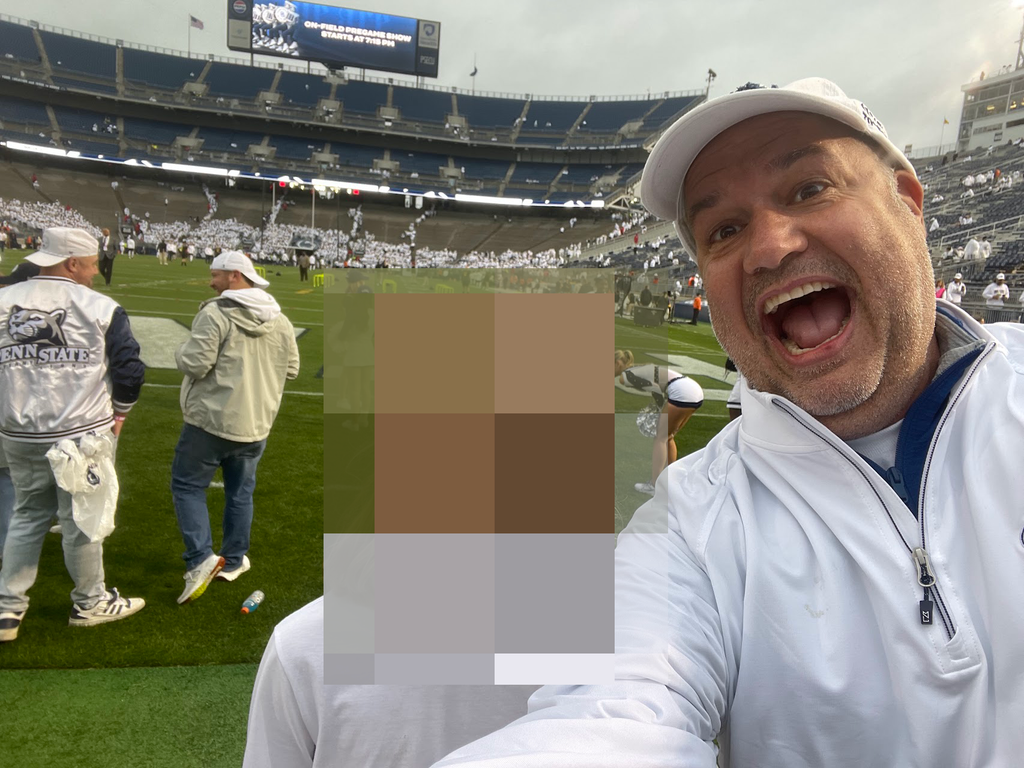
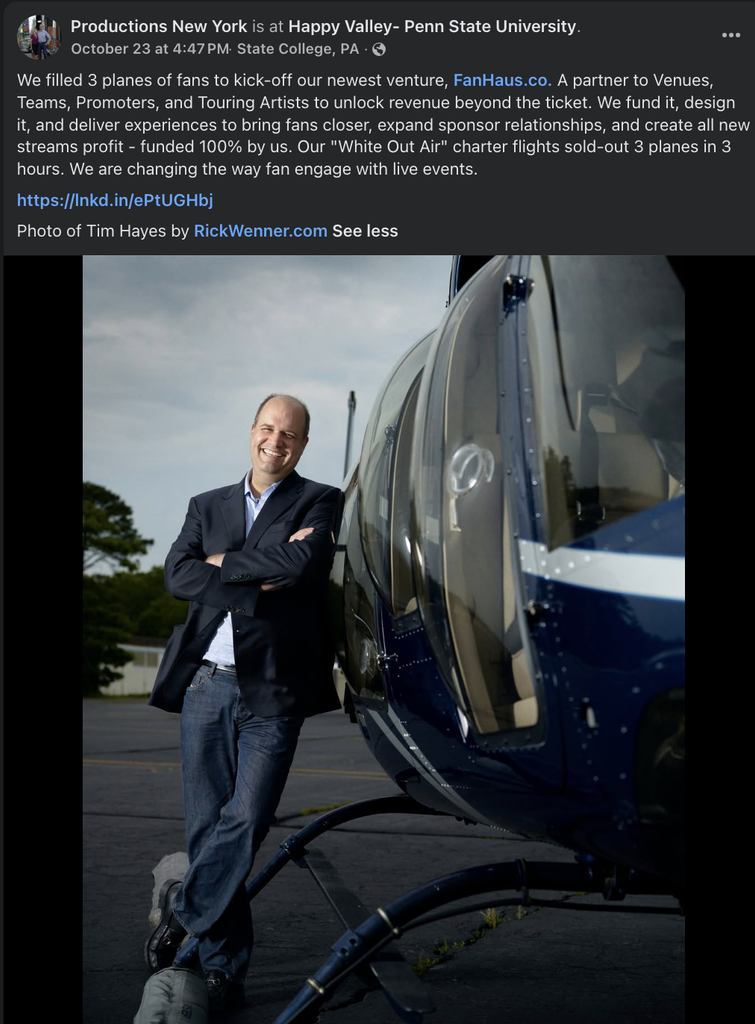
Included in the press release are two photos of Tim Hayes, who is listed as the co-founder. The first features Hayes leaning up against a helicopter, smiling in a casual business stance. The second is a selfie of Hayes and his son in the north end zone of Beaver Stadium with the caption “Tim Hayes with his son at the Penn State White Out.”
The press release continues.
“A ‘White Out 5K’ equivalent at the Super Bowl or traveling with a Harry Styles global tour can be an incredible way for fans to start the day together. We’ve engaged more than 2.2 million people celebrating without alcohol across our suite of event companies. The sober experiential space presents a huge opportunity for our partners,” continued Tim Hayes.
FanHaus.co is also solving the problem of lodging. The White Out reported a crowd of 114,419 fans in attendance on October 10, 2026 in a rural Pennsylvania region with less than 4,000 hotel rooms. FanHaus.co got their patrons home to NYC before some people got out of the parking lot.
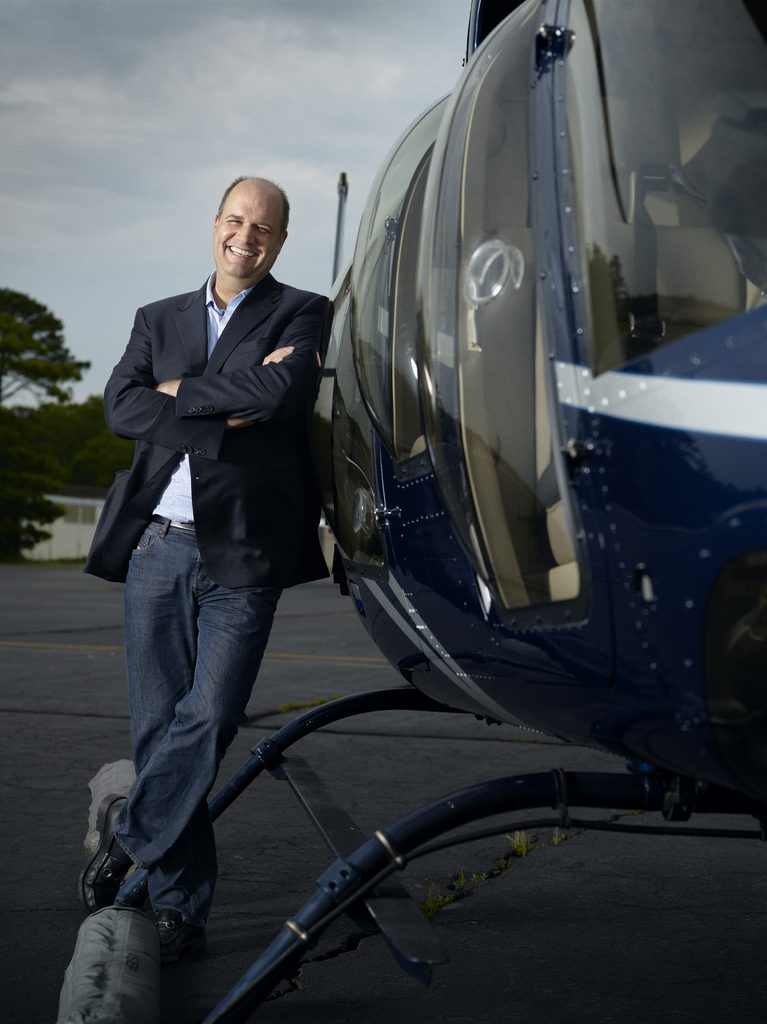
The connection to the helicopter and New York City is a similar message for Hayes. In 2015, Hayes was the co-founder of a company called Gotham Air. The company offered helicopter flights from downtown Manhattan to JFK or Newark, essentially eliminating the hassle of taking a taxi or train to those airports, for the cost of $99.
“Gotham Air is helicopter and luxury for the masses,” Hayes told Bloomberg in 2015.
In the interview, Hayes goes on to describe how the cost of helicopters isn’t necessarily the flight, but rather the cost of them sitting on the ground. Putting them to work is cheaper.
Hayes got the idea from working with Guns N’ Roses Duff McKagan. Hayes works in concert and event experience. At the time, according to his LinkedIn, Hayes was the owner of the CBGB brand – the intellectual property of the famous punk rock club in New York City. When working with McKagan, Hayes – as he told Bloomberg – asked McKagan to say a bit longer at something, offering to pay for a helicopter to the airport to mitigate any potential downtime.
“Then I got the bill for $2,300 and I thought isn’t there a way to make this accessible to everybody and it turns out there is,” Hayes said.
But by May 2016, according to the New York Post, Gotham Air, which went viral on the internet, had closed.
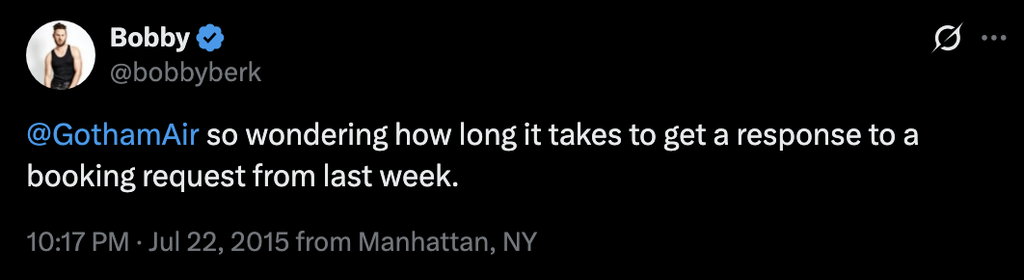
Outside of the company’s presence on news outlets and websites, there is little digital evidence left it existed. There is no website or Instagram page – though 2016 was a different time. The company’s Twitter page still exists but went dead around the time the Post reported the company closed. What mostly remains can be found in searches for @GothamAir showing that customers, including Queer Eye’s Bobby Berk, were having trouble with bookings.
Meanwhile, Hayes’ other company, Productions New York City, lists that it has helped “facilitate permits, local crews, and production services” since 2006.
That company still actively posts on Facebook and maintains a website.
However, it appears that for Hayes – along with partner John Greenberg – that FanHaus was a return to the skies.
After Hayes posted that FanHaus press release, the Instagram Buying Sideline made a reel about the company which reached more than 31,000 users.
In it, it was a similar refrain of what was in the press release.
It was also how I found out about FanHaus.
Upon seeing the reel, I went to the FanHaus.co website to reach out to Hayes. Traffic problems are one of the many pain points for Penn State fans and while this solution was not for everyone – both in terms of cost or location – it is an interesting solution for fans.
On Oct. 21, I first sent Hayes an email to the email listed at the end of the press release that is thayes@fanhaus.co and another email listed on the site for Hayes related to his Productions New York company.
In the interim, there were multiple inconsistencies with the website. First, many pages had odd URLs. A page that featured event production used the root of FanHaus.co plus “/copy-of-home”. Another, which featured AI-produced, was the root URL plus “/copy-of-activations”.
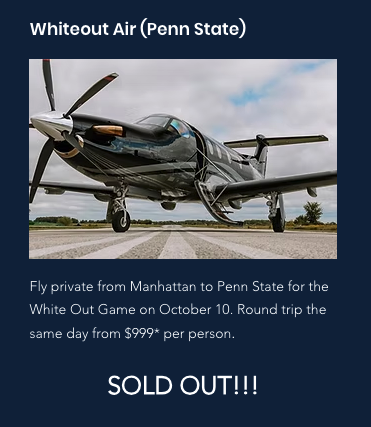
Outside of the home page listing that the Penn State White Out Air flight “sold out,” there was no obvious mention of the flights elsewhere on the site.
It was also around that time I came across the PR Newswire press release. In that press release, there is a photo of Hayes with his son – listed at the Penn State White Out game. It is not directly stated that it was the 2026 White Out – though implied given the press release was about that game.
In the background of that photo, the south end zone and west sideline are visible. At the top of the south end zone, there are no super ribbon boards. These are the LED video boards that flank the left and right side of the south end zone. They were installed ahead of the 2024 season.
Additionally, a sliver of the old press box, now replaced by Beaver Stadium’s west side renovation, is also visible behind Hayes.
After not receiving an initial email reply to my Oct. 21 email, on Oct. 26, I followed up with Hayes again – once again asking for an interview about his company.
But again, no answer.
Around this time, Penn State confirmed that it had no partnership with the company.
In the press release, FanHaus describes a “‘White Out 5k’ equivalent at the Super Bowl or traveling with a Harry Styles global tour.”
Penn State did not host a 5K race related to this year’s White Out – and essentially never has. That is one example of the erratic language used throughout the press release.
Penn State’s confirmation of the lack of a partnership also likely meant that Penn State did not receive any money from FanHaus. Though FanHaus never made such claims explicitly, it is implied by the line in the press release that says “while sharing up to 50% of revenue with athletic departments.”
Additionally, there was no public promotion of the three FanHaus flights to be found. FanHaus does not have a public-facing Facebook page and the only obvious mention of the experience on social media came after the game, when Productions New York posted about it on Oct. 23.
In a comprehensive review of Automatic Dependent Surveillance – Broadcast data, which is shared by flights for tracking purposes and published to places like ADSBExchange and FlightRadar24, only one flight from a New York area airport, in particular Teterboro, was found to have flown into State College on Oct. 10. It was a Cessna 525B Citation CJ3, which fits up to seven passengers.
After the game, which ended at 10:55 p.m., only one plane returned to the New York area directly between the end of the game and 2:40 a.m.
That lone flight to the NYC area – N43VU – left at 12:06 a.m. for Danbury Municipal Airport in Connecticut. The aircraft used for that flight was a Cirrus SR20, which is a single-propeller plane that features four seats, one for a pilot and three for passengers, configured similarly to a sedan. It typically would not be used for private travel that an audience like FanHaus would appeal to.
| Time | Destination / Location | Airport Code | Ident / Tail Number | Aircraft Type |
|---|
In the press release, Hayes said the company sold out “3 planes in 3 hours.” The release also claims that “FanHaus.co got their patrons home to NYC before some people got out of the parking lot.” This implies there were three flights into State College and at least one back to Teterboro using the same aircraft coming in.
On Thursday, Nov. 12, I reached back out to Hayes and added Greenberg, who were both listed on an about page on the FanHaus site, to both an email found for Greenberg elsewhere, his listed FanHaus email, Hayes’ Production New York email and his FanHaus email, presenting the facts that it was unlikely three flights from the New York area arrived or left State College that day, among other questions about the company, with a deadline of Monday, Nov. 16 at 5 p.m. ET to reply.
Within an hour of my email to Hayes and Greenberg, Hayes responded, asking to call his cell phone number to chat. In that email, Hayes also clarified the photo taken on the field at Beaver Stadium was not from this year’s White Out but meant to show that he was a passionate fan.
Shortly after, Hayes also responded that the FanHaus emails were “between servers,” meaning they weren’t active. However, those emails were publicly listed on the FanHaus site and included in the press release posted on PR Newswire as a way to contact the company to learn more. Using the Wayback Machine, which lists the first scan of FanHaus.co on Oct. 12 — the same day the press release was published and two days after the game — the email travel@fanhaus.co was listed to contact if interested in the flights.
Last Thursday afternoon, I called the number Hayes provided for a conversation but did not get an answer, leaving behind a voicemail.
Greenberg never replied to the email.
After no return call from Hayes on Thursday, Friday and Saturday, Hayes responded to my email on a separate thread without Greenberg with this statement on Sunday evening.
“As a prelaunch exercise, we invited associates, corporate clients, and friends to make the trip thinking we might justify one small plane. We quickly sold enough to warrant three small aircraft to a group from a single company. At that point, it made sense to consolidate into a single plane, which was a happy success[.] [sic]
“Tour companies generally do not operate aircraft and we made no representation to imply otherwise. Clients accustomed to private travel often request itinerary changes and modifications; this is one of the benefits of bespoke services. We have strict non-disclosure agreements with our partners and clients.”
In a review of the FanHaus site metadata, there was a page that listed two flights to State College and the ability to submit an email to learn more. On the page, information was given how passengers would board a helicopter from “JAR” to Teterboro, where they would take a Pilatus PC-12 aboard a “third party Part 135 air carrier” at either 12 p.m. or 4 p.m. PC-12s seat – like that Cessna from Teterboro – six to nine passengers.
In Hayes’ Facebook post, he said FanHaus “filled 3 planes of fans to kick-off our newest venture.” But the only plane, the aforementioned Cessna 525B Citation CJ3, that flew into State College on Oct. 10 seats roughly seven people. No other jets bigger than that came from the New York area via Part 135 carriers. This both contradicts the Facebook post made by Productions New York about three flights and the statement provided by Hayes that the three flights consolidated into one. It was also not represented on the site that three or one flight would be made — only two.
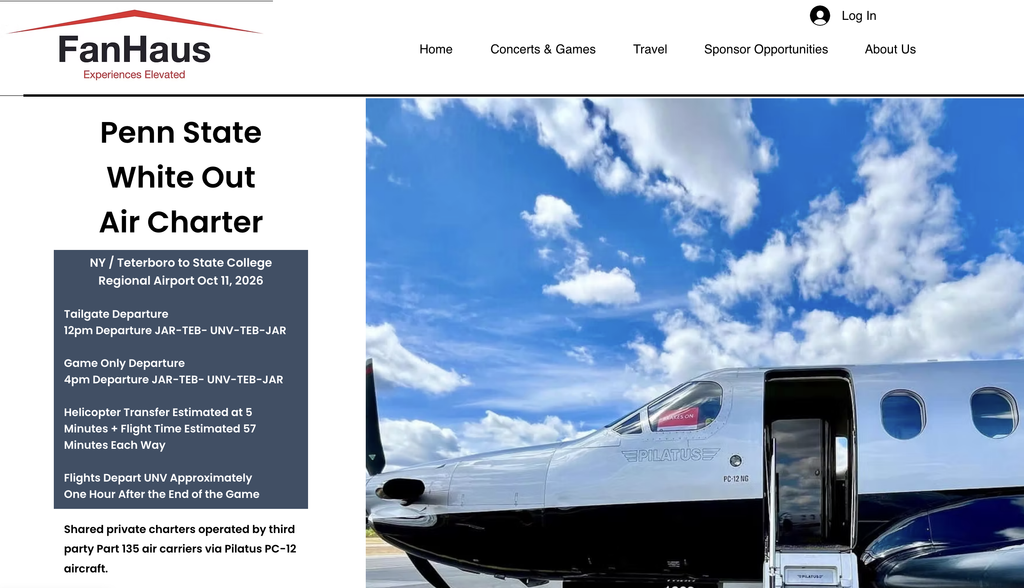
Further, the date for the flight was listed as Oct. 11, not Oct. 10.
Oct. 11 was a Sunday. Penn State played on Saturday. Additionally, “JAR” is likely a typo for JRA. That abbreviation is the IATA code for the West 30th Street Heliport, which is where helicopters to Teterboro often take off.
A comprehensive check of Part 135 carriers and their aircraft showed only one PC-12 that flew out of the State College Airport on Oct. 10. That flight left exactly one minute after the listed end time of the Penn State-USC game. It flew to the airport in Lancaster and remained there until Oct. 31.
When specifically asked after his reply on Monday for the name of the Part 135 air carrier and the flight number(s) in and out of State College, Hayes responded with the following.
“This project has not launched. Some draft content may have been published inadvertently. We will work to correct any potential errors after review before launch.. [sic]”
In the hours after his reply, Hayes changed the home page of the website to a “coming soon” page with the FanHaus logo.
The page to contact FanHaus about the White Out Air flights is now a 404 error, which means – much like the three purported flights – it is not found.

If you’ve enjoyed this content, please subscribe to Stuff Somers Says With Steve on YouTube. Or join our newsletter by entering your email below.
