
Since 1960, there have been constants in and out of Beaver Stadium.
Every Saturday morning in the fall, the sun rises over Mt. Nittany and points directly at Gate A.
The sun comes up above the crest of the mountain and rides it across the sky.
This Saturday, that will start at 7:05 a.m.
At 8 a.m. the temporary tenants of the parking lots and the grass fields surrounding the stadium will begin to fill up – though some of the people in the lot northeast of the stadium will have been there since Thursday night.
The sun will work its way around the back of the south end zone, working its way across the outer barrier that defines Happy Valley and then follow University Drive. Those on the west side of the stadium will bask in the warmth while downing Pennsylvania’s finest amber lager and the Pennsylvania Dutch’s potato chips – almost always part of the spread on a Saturday.
By 1:30 p.m. the gates will open inside Beaver Stadium and before the sun goes down, Penn State fans will make their way to their seats to watch a football game.
That will not change after 2026. That will not change in 2027. That will not change for many sunrises and sunsets to come as long as there is Penn State football.
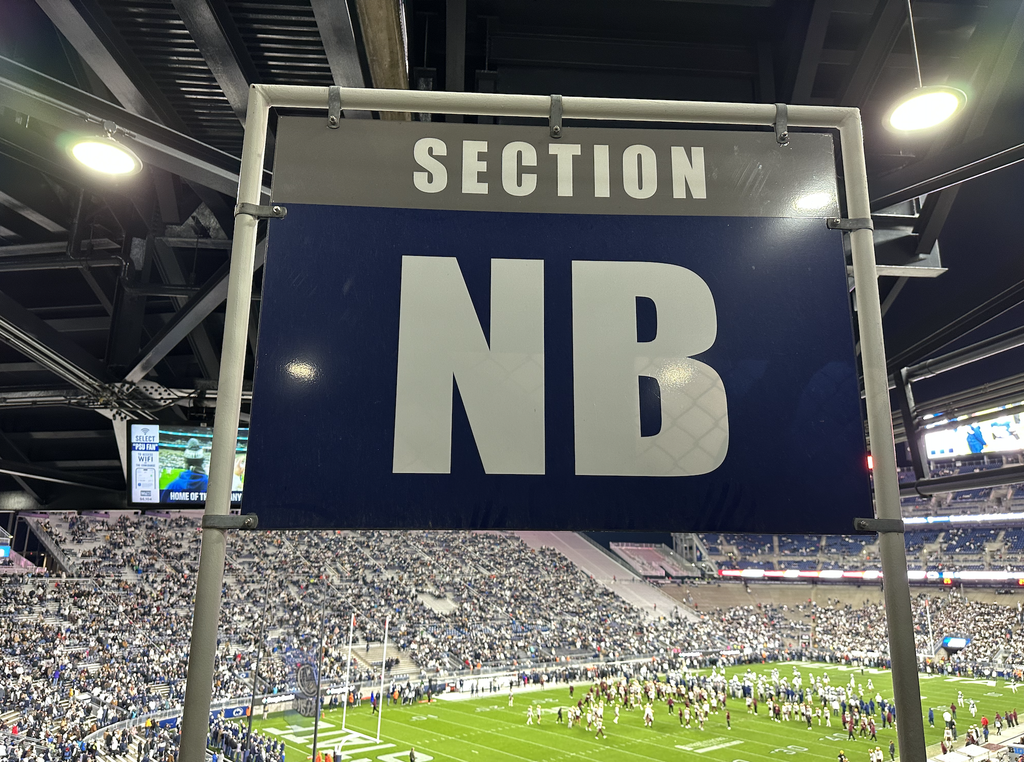
But for the final time when Penn State fans make their way to their seats on Saturday, they will be looking for a section like NB, SHU, WB or EF.
Saturday will be the last chance to see letters, not numbers, on the tickets that allow admission to the Erector Set at Curtin and Porter.
The end of the alphabet inside Beaver Stadium is here, and with that, the end of one of the uniquely underappreciated things that make the gigantic place feel like home.
Ahead of a $700 million renovation, slated to be completed by the start of next season — and slated to be heavily restarted before this one ends – Penn State has announced that next year, Beaver Stadium will transition away from its lettered sections with odd numbers being on one side and even numbers being on the other.
Penn State will instead – as it has done on the newest part of the stadium – switch to a number system. The lower bowl will no longer be directionally focused, instead being the 100 level and from there the stadium will run all the way up to the 400s – at least for now. Sections will now be contained within two aisles on either side and none in the middle.
Since the time Penn State picked up the pieces of New Beaver Field and marched them down to the other end of campus, directional letters have guided those in the then 44,000-seat stadium to now the at-least 114,419-seat stadium on where to sit.
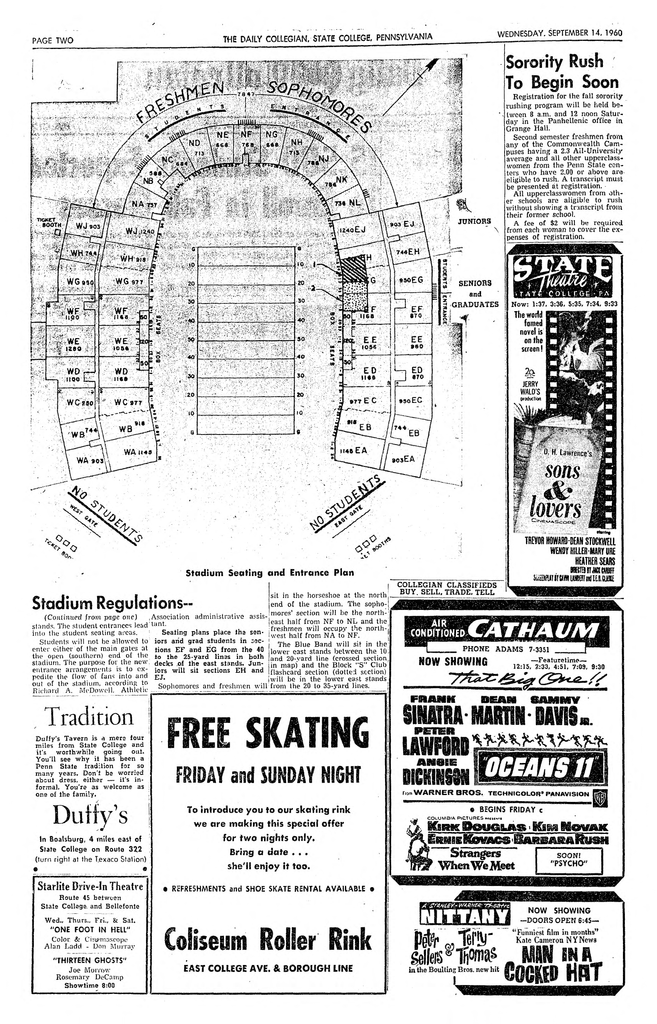
East and West are the sidelines. North and South are the end zones. Pair the direction’s first letter with another letter between A-L but not I, and you’ve got your section inside Beaver Stadium.
Though when Penn State moved the stadium to its present location, there was no south end zone seating and the students – who now occupy that end zone – were asked to sit in the northern part.
Still from WA all the way around to EA – then eventually from WA to SK – Beaver Stadium’s seating map has been one of its unheralded features. Most other stadiums around the country use numbers – though Ohio Stadium used the AA, A, B, C and D-decks with a number appended. (I recommend not opting for the B deck because chances are you’ll be behind a column.)
Michigan Stadium – what may be the largest in the country just ahead of Beaver Stadium – uses a simple number system from 1 to 44 with a ton of rows. It’s up to urban legend on just how many inches per seat they give, though.
But inside Beaver Stadium, where the sun will hang over the northwest corner for part of the first half on Saturday, the lettered sections have been the law of the land. They are as dependable as someone eventually coming into your row, taking a seat, only to realize that NA even is actually over there.
The numbers of the seats will also now go from left to right – or maybe right to left – in a sequential fashion by one instead of two. That was part of the quirk, the principle of the awkward conversation you’ve had to have several times with someone who is in your seat and is part of why they are addressing it in 2027. For those superstitious like me, who specifically chose the seat because it was their lucky number in a row that is also a meaningful number to me and my wife, there is also a bit of anxiety – and potentially obsessive compulsion – that removing the even-odd seating in the lettered sections will bring bad vibes.
But that’s a problem for next year.
Right now, the more immediate concerns come from the loss of something that gives Beaver Stadium a bit of identity – even if it’s only known to those who have ever attended a game there and barely at that.
Without the letter system, Penn State fans would not know where to sit every game – and I would reckon there is a non-insignificant number of Pennsylvanians who learn the location of the cardinal directions because of the way the stadium is organized.
The sections and their letters have not fully become iconic – certainly not as iconic as the stadium’s capacity itself – but they’ve been such a common place that when someone gives you their section when you ask them where they sit, you can envision exactly where that is.
Next year we will all have to start over – and for some folks – that will come with being displaced from seats like WC that their grandparents had when the place opened on Sept. 17, 1960. Privileged problems, yes, but micro inputs that give places like Beaver Stadium – and the memories that are another constant to the place – context and substance.
The letter system’s end will become just another part of the homogeneous changes coming to college athletics both near and far that slowly have stripped some but not all of the soul out of the institution that is college football.
It’s one of the changes that we just have to accept. And this one in particular may not be the change we all need to necessarily worry about.
But acknowledging the end of the seating system is at least important because for 66 years, Penn State fans have taken it for granted. It has always been there for us, helping us find our way and our seat.
It’s a fundamentally essential part of the gameday experience and it was uniquely Penn State’s.
By the time the sun sets at 4:48 p.m. over the NB on Saturday night and the clock eventually zeros a few hours later, one constant of gamedays will be gone: vowels and consonants.
 at

Time: 3:30 p.m.
TV: FS1
Announcers: Noah Reed, Petros Papdakis
Radio: Penn State Sports Network
Announcers: Steve Jones, Jack Ham, Brian Tripp
If you’ve enjoyed this content, please subscribe to Stuff Somers Says With Steve on YouTube. Or join our newsletter by entering your email below.
