It appears Penn State may have jumped the gun on sharing its NIL data.
The NCAA Membership Financial Report, which is released in the early months of the year, is required by the NCAA for various purposes. However, it is not required to be released publicly by any school. For state schools in states with more direct Freedom of Information Act (FOIA) laws than Pennsylvania, journalists will often request the report. Some private schools do not share their reports at all with the broader public.
Penn State, however, because of how it operates as a semi-state, semi-private institution, has in good faith – and potentially for good PR purposes – released its reports directly on its website and has since the Fiscal Year 2011 report.
Over the last few years, since we launched the blog, we have provided detailed breakdowns of those reports. The most recent edition of the report included some new numbers around NIL.
Penn State reported NIL revenue-sharing data in its latest report, which, on the surface, is important information. This, for the first time, gave us a glimpse into how Penn State was dividing its funds across its teams, even if it’s potentially not a full picture.
The information can be found under the “Institutional NIL Revenue Share” section, which is the last item of spending reported out by Penn State. There, Penn State reported it spent more than $18 million in 2024-25.
However, school-supported NIL revenue sharing did not begin – at least mandated by the NCAA under the House settlement – until July 1, 2025, the first day of the FY26 reporting year. That report will come out in early 2027. Of course, NIL has been around since 2021 but through third parties that are related but not directly tied to institutions.
It appears, however, that Penn State has reported NIL funding – likely from the Happy Valley United pool of money – as the NIL revenue being shared and could likely explain why Penn State saw a 124 percent year-over-year increase in contributions allocated by sport and an overall contribution increase of 74 percent.
Further, a review more than 15 other schools with NCAA Membership Financial Reports available through various means shows that those schools did not report NIL spending. Ohio State, Illinois, Iowa State, the University of Utah, the University of Virginia and the University of Alabama, among others, all show $0 in NIL revenue sharing among their teams. While it is difficult to gather all of the information because of the lack of uniformity around the rules of sharing the report, it is believed Penn State is the only school to share the NIL data. This would mean that compared to Penn State’s peers, the school overreported its revenue and spending for FY25.
Penn State did not respond to initial questions about the financial report – and generally does not answer questions related to the financial reports.
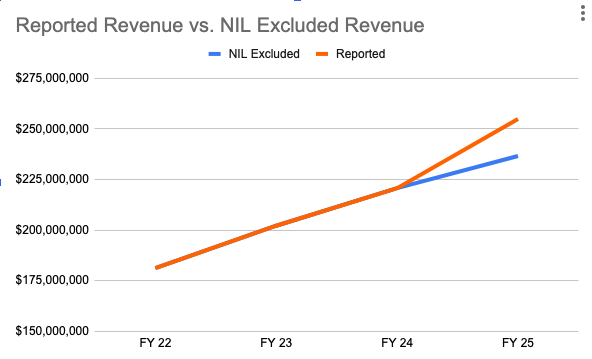
On the whole, Penn State saw its revenue and spending increase by $34 million and $39 million, respectively, year over year. The roughly $252 million both earned and spent is the highest ever in the athletic department’s history. This is also the largest total jump year over year since the 2021-22 report. The jump equates to a 15 percent increase in revenue, the largest percentage change since 2021-22 and an 18 percent increase in spending.
However, with the NIL contributions removed, Penn State would have generated $236 million in total revenue, meaning that FY25 saw a just 7 percent increase in revenue instead of the 15 percent reported.
Since the FY22 report, Penn State has generally followed a linear progression for anywhere from 9 to 12 percent in year-over-year revenue growth. While the 7 percent increase is down yearly, it follows a general progression in line with those other years. The 15 percent increase, however, at this scale, is a significant increase.
Furthermore, with various sports, Penn State saw drastic year-over-year changes when it came to contributions as reported. For example, wrestling saw a 679 percent year-over-year increase. Penn State baseball saw a 43 percent year-over-year increase in contributions.
But if the team-allocated NIL revenue share numbers are removed from the team-specific contributions, Penn State wrestling saw a 309 percent year-over-year increase in contributions. Penn State baseball only saw a 5 percent increase in contributions.
Additionally, Penn State football saw contributions increase by 305 percent as reported. But if NIL contributions are removed, Penn State saw a 2 percent decrease in contributions year over year. This number somewhat aligns with the fact Penn State football saw a small decrease in ticket sales year over year – about 0.43 percent.
Overall, Penn State reported $64 million in contributions. Roughly $37 million of that was attributed to a specific team in the FY25 report.
In total, Penn State reported a 124 percent increase in contributions allocated by sport. But with the NIL numbers removed, there was only a 13 percent year-over-year increase in team-allocated contributions.
| Contributions | Men's Teams | Women's Teams | Unassigned | Total |
|---|---|---|---|---|
| 2025 Reported | $30M | $6.99M | $27.4M | $64.5M |
| 2025 NIL Spending Removed | $11.8M | $6.87M | $27.4M | $46.1M |
| 2024 | $9.7M | $6.84M | $20.4M | $37M |
| 2025 Reported YoY | 209% | 2% | 34% | 74% |
| 2025 NIL Spending Removed YoY | 22% | 0% | 34% | 25% |
Non-team-assigned contributions increased 34 percent. That equates to roughly a $7 million increase in total. From the FY23 to the FY24 report, Penn State reported a $549K drop in non-assigned donations.
It’s not impossible to think, especially as Penn State begins collecting funds for its stadium renovation and reported its highest year ever of giving for athletics, that it saw that $7 million increase naturally.
The inclusion of the NIL numbers seems to be a rare quasi-leak of financial information that, because of Penn State’s status of protection under Pennsylvania’s sunshine laws, makes it difficult to obtain more information.
It is also unclear if there are external NIL funds or if this was the total that all Penn State athletes received. The latter seems unlikely given that teams with athletes that did not have any funds reported have members that have NIL deals.
While this does mean Penn State overreported its numbers compared to the peer set, it does pose questions around transparency with NIL giving and spending. NIL funds in the IRS are not seen as 503c3 status after relatively fast legal pushback. And while funds sent to Happy Valley United or other NIL entities around Penn State and other schools aren’t being filled out to the school directly, there is still a very close tie between the school and the collective.
But this data from Penn State – at least in part – appears to be an unintentional moment of that transparency.
If you’ve enjoyed this content, please subscribe to Stuff Somers Says With Steve on YouTube. Or join our newsletter by entering your email below.