


EVANSTON – The optimistic views of this season featured a Penn State team in control of a number of games this season. This Penn State football team had what it takes to be a consistent winner in the Big Ten – even in the face of a heavily transfer roster that was a mashup of Penn State and Iowa State.
There was a sense this process – one in which Penn State was starting a new era of football – could be handled with a relatively brisk pace. There was heavy investment in key retention, mixed with stability and familiarity from transfers coming in. There was optimism that the new coach, a proven winner at every stop prior to this one, would be able to do more with more.
Then Northwestern ran for 413 yards.
Penn State didn’t just lose to Northwestern on Friday night, 34-13. It got thrashed in a fashion that served as a reminder that there are no shortcuts in this conference, and the process for starting over will not be completed quickly.
In the offseason, Matt Campbell spoke repeatedly about how Penn State would handle adversity when first faced with it. The topic was a point of emphasis, key in preparing Penn State’s roster for the bumps of the Big Ten schedule. It would be a foundational block for the potential of this season – one in which is a schedule that avoids Ohio State, Oregon and Indiana. It was the type of season – and the opportunities within it – that sets strong futures both in the immediacy and future.
By the end of the Wisconsin game, one where Penn State blew a 17-0 lead, the adversity arrived in the form of an ineffective offense that could not seal a game off from a pesky Badger team.
This week, Penn State and Campbell spent much of their media availability explaining how Friday’s game with Northwestern provided the first opportunity to correct the adversity.
But from the moment the Wildcats stepped onto their new $850 million field for the first time, Northwestern made simple work of Penn State’s defense. Meanwhile, Penn State’s offense could not string together a semblance of an attack.
Caleb Komolafe and Joseph Himon II repeatedly gashed the Nittany Lions’ defense for 237 yards combined by halftime. The regression for Penn State’s defense — who played strong against Wisconsin but ran out of energy late — was visibly alarming as the Wildcats only struggled when they instead turned the ball to the air. In the second quarter alone, the Northwestern offense had runs of 36, 38, 24 and 11 yards on two touchdown drives of just five plays total.
Penn State linebackers repeatedly missed tackles while the bulked-up defensive line from a year ago failed to generate any penetration into the backfield.
The 413 yards are the second most Penn State has allowed since 2010, when it allowed 418 to Michigan in 2022.
And much like a week ago, Penn State’s offense provided no relief. It was 5 for 14 on third downs and only racked up 23 minutes and 55 seconds of possession, preventing the defense from getting a rest.
Fourth-year starting quarterback Rocco Becht played in a fashion that can only be described as chaotic and inexperienced, missing open receivers and passes early, despite the fact that he is far too experienced to be that. When Penn State, who averaged just 4.7 per carry entering Friday’s game, needed its passing game to be better in order to beat Northwestern, it somehow got even worse. Becht finished the night, going 26-for-41. He had several passes tipped at the line of scrimmage – which continues to be a problem in a bigger Big Ten compared to the Big 12 – and threw two interceptions.
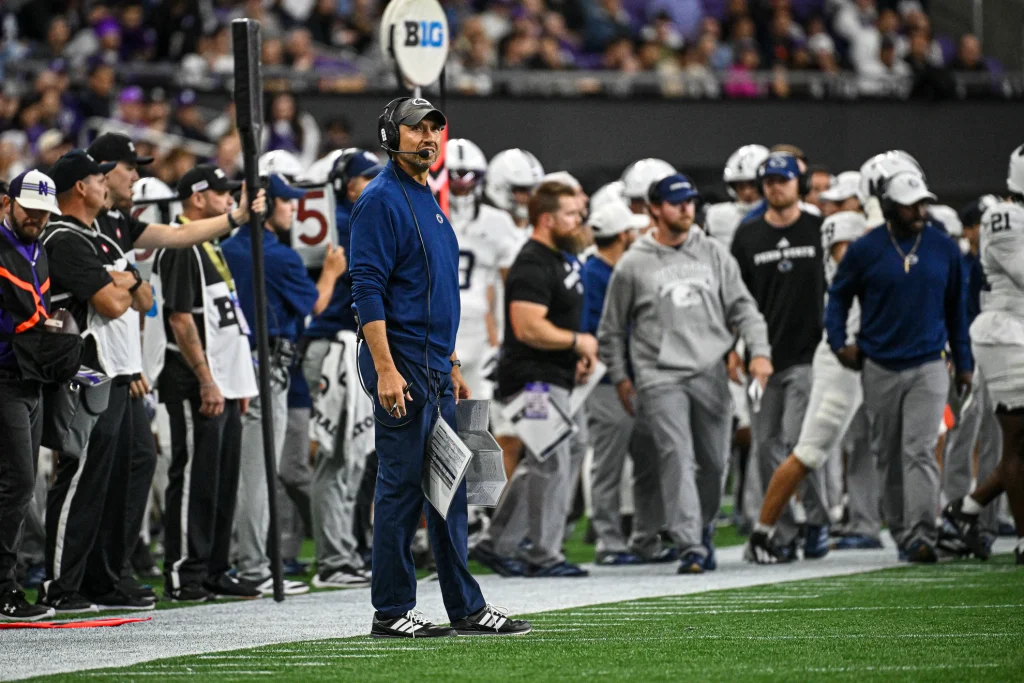
Campbell himself also coached a baffling game. Prior to the half, Penn State – which trailed by 17 – drove down the field into Northwestern territory and after an incompletion on 3rd and 5, the coach sent the field goal unit out to attempt to cut the deficit to 14. But Ryan Barker – who was steady last season – missed the 48-yard kick, his second miss of the year.
Then on a critical drive in the third quarter, Campbell punted from the Northwestern 43, still down by 17 points. Penn State, which needed a killer instinct a week ago against Wisconsin, desperately needed it again in that moment. Yet Campbell failed to allow his team the opportunity to correct that.
The logic like that, and other decisions throughout the night, was puzzling. So too was Campbell’s decision to keep Becht in the game as the quarterback only got worse throughout.
Many of Penn State’s pain points last week felt like correctable issues but this week, they felt like concerning friction points that only long, process changes can address. Nowhere, though, on Friday night did it feel like Penn State tried to address those. Instead, it approached another game of Big Ten play with a bullheadedness that has now caused two straight losses, when many tabbed this team to lose at most three.
Big Ten play is unforgiving and Penn State, as well as Campbell, has approached it with a forgiving manner. Campbell has emphasized a considerate process and mentality in his press conferences but that does not appear to be what Penn State needs.
That attitude may only cause more pain if it continues to linger, slogging through this entire rebuild process. But with the investment and attention required by a place like Penn State, it is far more unforgiving.
If you’ve enjoyed this content, please subscribe to Stuff Somers Says With Steve on YouTube. Or join our newsletter by entering your email below.