
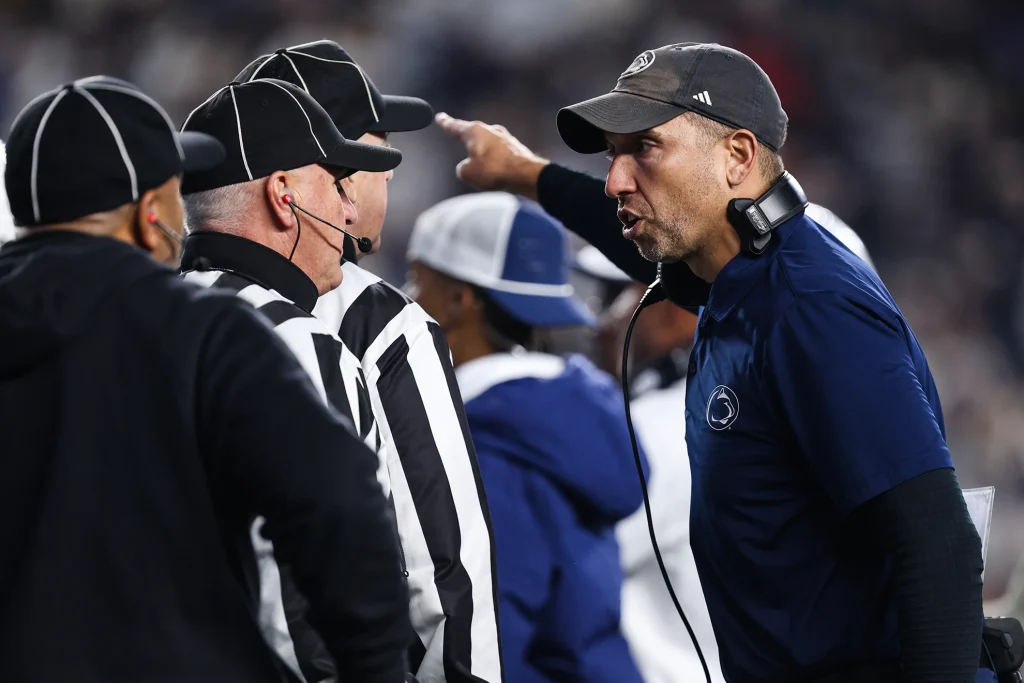

In a matter of three hours, any goodwill earned by Penn State and Matt Campbell was erased on Saturday afternoon.
In the most embarrassing loss the 21st century for this program – a century that includes losing a game 6-4 – Penn State collapsed in the second half to a 2-8 Rutgers team, 25-24, when it was a 25-point favorite, playing against a backup quarterback with several injured ribs, with no real threats and for a program that Penn State had only ever lost to twice in 35 prior meetings.
Any bit of good feelings that were built on a three-game winning streak that was turning around this season shattered on the turf of Beaver Stadium on Saturday night, and with it, the possibility of being excited for the future is nowhere to be found.
Penn State held two leads of 16 and 14 points and yet it allowed Rutgers to re-enter the game through dumbfounding decisions and inconsistent play – which returned in a similar fashion from a Wisconsin loss earlier in the season.
While Penn State opened with a 7-0 lead, a drive into the red zone stalled out as Penn State failed to convert on a goal-to-go situation from the one-yard line. In that sequence, Penn State couldn’t gain the yard it needed on the first play with a run on first down by Cam Wallace – starting for injured Carson Hansen. Then fifth-year quarterback Rocco Becht took a sack – with plenty of time to get rid of the ball – on second down, a refrain of his earlier goal-to-go decision-making struggles. And Penn State failed to punch it into the end zone on the final two plays.
While Penn State would hold Rutgers to a safety after the turnover on downs and score another touchdown to jump out to the 16-point lead, Penn State’s inability to close out the game lingered like Becht’s indecision to throw the ball away.
Another head-scratching decision came off the kickoff when Penn State went up 16-0.
Initially, Penn State sent the ball to Rutgers’ Clay Thevenin with his feet in the end zone and, despite a lateral, contained the Scarlet Knights to inside of the 20. But an offside penalty by the Nittany Lions forced a re-kick. On it, Penn State purposefully kicked the ball to Ben Black, line up well above the end zone and he was able to take the return to the 42-yard line.
That starting field position allowed the Scarlet Knights to work their way down the field, scoring their first touchdown inside of Beaver Stadium since the 1994 season.
That touchdown was a turning point that Penn State struggled to respond to.
On defense, Penn State couldn’t get a stop either. Rutgers possessed the ball for the 10:17 in the fourth quarter – in part because Penn State’s offense managed just 26 yards of offense in the final frame.
And with 3:28 left on the clock after a three-play, 5-yard drive that lasted 1:37 by Penn State, Rutgers took the ball back and worked its way down the field, aided by a pass interference penalty that allowed the Scarlet Knights to go from the PSU 41 to the PSU 26.
As Rutgers threatened thanks to the passing attack by AJ Surace, who finished with just 178 yards, Penn State held Rutgers to a 4th down nine yards away from the end zone. It was then called for a questionable pass interference call to extend the Rutgers drive.
Then, as time expired, Surace found Antwan Raymond out of the backfield who, before he was put on the ground, lateraled to Black, who scored.
Rutgers was able to then complete the two-point try on nearly an identical play design to Thevenin. For the first time since 1988, Rutgers had beaten Penn State. For a team that lost to UMass earlier this year – and did not have a Big Ten win to its name – the Scarlet Knights jubilantly celebrated in all corners of the field of Beaver Stadium.
Meanwhile, Penn State and its fans looked lost. It was a stunning collapse by Penn State, which now enters the final weekend of the season with any momentum it gathered over the last few weekends evaporated into thin air.
It’s also the type of loss with no resolution or rebound that can be addressed by next season – and only adds to the frustrating sentiment that has been stagnant over Happy Valley the last two seasons.
Penn State has no real options for a solution. A win over Maryland is at least not a loss to Maryland – which would be almost as disastrous as the Rutgers loss. A win in a bowl game means next to nothing these days for a school of Penn State’s stature – in part because the sport has been boiled down to success defined by a 12-team bracket.
Next year, it expands to 24 but for Penn State, the road will only get harder with a more challenging schedule – at least on paper in 2027 compared to 2026. If Penn State struggled with arguably one of the easiest schedules in the country, avoiding all but one of the top 15-CFP-ranked Big Ten teams, what excitement can be found in 2027?
Then that leaves the internal changes that the triad of Penn State’s football leadership could theoretically make.
The ire of much frustration during 2026 has been pointed at Penn State athletic director Pat Kraft. While firing him isn’t entirely out of the realm of possibility, it would be a difficult look for Penn State president Neeli Bendapudi. Kraft, who has a contract that runs into the next decade, is the key leader of Penn State’s $700 million Beaver Stadium renovation — with construction set to resume Sunday.
Firing Kraft now would mean an admission of a failure that he is not equipped for the role, which is a difficult look, particularly to high-level donors supporting the Beaver Stadium renovations, undermining the decision-making process in the first place. That move would also rile up the proletariat portion of the fan base who already feels that the renovation is only designed for the wealthier fan.
That average fan is and was already being squeezed for more money both by Penn State and outside forces. The $700 million renovation has largely been about premium areas and additions to Penn State’s 66-year-old stadium. Those premium areas come at a steep cost for a fan base that still aligns itself as mostly middle-class and blue-collar. The average portion of fans will not ever see or use those areas. But meanwhile, some fans who sit on the west sideline and have sat there for decades are facing sharp increases of hundreds of dollars per ticket to retain their view. For the rest – and most of the season ticket holder base – fans will incur at least a $90 per ticket increase. The sentiment for the stadium renovation has only soured because of the implications it has had on those who may never use one of the club seating areas.
That cost increase comes at a time when other outside factors like hotels, gas and food costs for football travel – and all other aspects of life – continue to rise. To its credit, Penn State has offered discounted parking and discounted ticket packages – but to non-season ticket holders. Costs at concession stands around the stadium also increased at the start of the year.
As tickets have gone for less than $15 per game on secondary sites for the last three home games, it raises the question about what value fans are getting when buying season tickets. And when the view – particularly on the west side – gets changed at a steeper increase, both literally and financially, it leaves those leaving Beaver Stadium last night wondering if this is all really worth it.
Why should fans be excited to renew those tickets?
To the average fan, firing Kraft would send a message that also undermines why the stadium renovation decision was made in the first place too. That only sows more distrust between the school and its fanbase that only winning could attempt to fix.
Yet, Penn State isn’t even doing that right now and it’s hard to find belief that will change when there is now no proof of it.
Campbell will at least be at Penn State for two more seasons, as admitting failure on the hiring would still be premature and financially irresponsible – especially with that $700 million bill – by Kraft. Campbell likely can’t fire any of his assistants, at least just yet, because Saturday’s loss to Rutgers was not the fault of one area – but instead all corners of the program.
That then only leaves the future for this roster to poke at, which only looks murky because of the state of college athletics. Penn State has the 20th recruiting class in the country slated to sign by 2027. There is no quarterback actively in it, which means that Penn State will either need to pick one out of the portal or use Alex Manske as the starter next season.
But that feels both risky – even if the talent is developed internally – and adds to the fans’ frustration. It’s becoming increasingly rare – especially on this roster – for fans to make relationships with their players, as many of them relatively appear out of nowhere via the transfer portal. Homegrown guys like Tony Rojas and the connection fans have with them feel fleeting in this era as well.
And there’s no guarantee that portal quality will translate in Big Ten play – as Penn State has shown at times this season.
Losing to Rutgers only reopens all of the problems that Penn State put away in a three-game winning streak because of damning a loss like this is.
It’s a reset and a re-exposure of problems lurking in the closet that winning should have fixed.
And now, after the embarrassing loss, everyone is left to wonder who, what and when that fix will be.
If you’ve enjoyed this content, please subscribe to Stuff Somers Says With Steve on YouTube. Or join our newsletter by entering your email below.
